The Golden Era of the Scientific Method
Sir Isaac Newton - Master Practioner
Copernicus, Kepler, Galileo. These three titans had each chipped away at the once seemingly impenetrable edifice of Geocentrism. However chipping away is not the same as providing a fully fledged alternative, and people need a complete narrative to which their emotions can be attached and around which their belief structure can coalesce. People don't abandon falsehoods because they are wrong, they abandon them because a newer explanation has a simpler narrative that explains more. Conventional wisdom is neither conventional nor wise - it is the route of least resistance. The vast majority of people believe the world is round today, for the same reasons the vast majority of people believed it was flat in bygone days - and those reasons are not scientific. Though there was abundant evidence that the geocentric model of the universe was wrong, conventional wisdom still needed the glue that would bring all the moving parts into one simple story - there was an emotional vacuum to the discoveries. Filling that volume would fall to a prolific English polymath by the name of Isaac Newton!
The central contributions of his predecessors were: Copernicus - the theory of a heliocentric universe; Kepler - formulating the three laws of planetary motion, discovering that planets orbit the sun in an ellipse and not perfect circles and; Galileo Galilei - the discovery and correct interpretation of the topography of the moon, the four moons of Jupiter, the full phases of Venus, and sunspots. Newton is one of the most prolific scientists of all time. We are not here interested with a list of his accomplishments, but rather with his contribution and impact on the geocentric vs heliocentric debate. We want to know how his voice allowed mankind to grow in our understanding of the nature of reality.
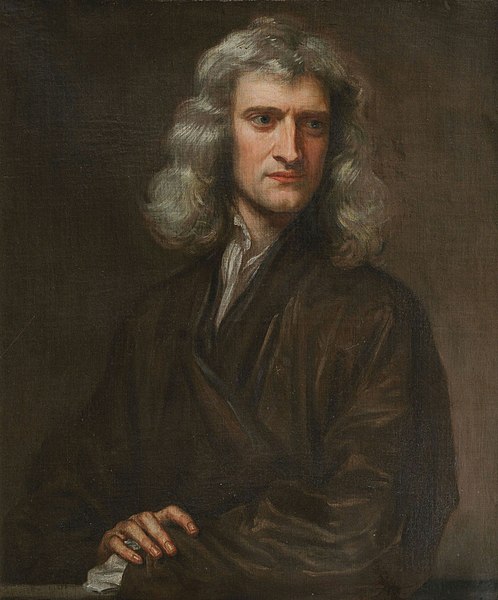
Newton was a firm believer in the scientific method and strictly abided by it throughout his prolific scientific career. He was a man who loathed hypothesis and empty guesswork, preferring the rigours of experiment and observation, instead. In all his years of scientific work, the man who came to be known as Sir Isaac Newton, due to his profilic accomplishments during his life, never, not once - gave in to the temptation to pronounce an empty hypothesis on a subject under study, when he didn't have any proof for its validity. It is for many reasons, this one chief among them, that Sir Issac is considered by many, to be the greatest scientist who has ever lived.
His first gift to humanity was the formulation of the law of gravity using Kepler's three laws of planetary motion as his starting point. Kepler's third law of planetary motion states: "The square of the orbital period of a planet is proportional to the cube of the semi-major axis of its orbit." The orbital period is the time it takes the planet to complete one revolution around the sun. the major axis of its orbit is its diameter, making the semi-major its radius. In plain English then, it means the cube of the radius (multiply it by itself three times), then square the time it takes to complete one cycle around the central body, in our case the sun. Lastly divide the cubed number by the squared number. When Kepler performed this calculation for all the then known planets, he discovered it was the same value for all of them. In other words it was a constant. (His theory holds for any objects orbiting gravitationally around a common body.) Kepler arrived at this mathematical expression by looking for hidden relationships between the radial and orbital period variables for different heavenly bodies. After many years of methodical calculations, the relationship became clear to him as detailed above. He didn't live long enough to explain why this value was a constant. Newton through his law of universal gravitation was the one who explained why this value was a constant. But the matchless Newton was only getting started!
Book 3 of Newton's scientific magnum opus Principia, dealt with how gravity acted on objects and was entitled System of the World. It contained Newton's most profound insight about gravity. What he had done until then was merely give mathematical proofs to what had already been acknowledged to be true, but what he did next made it impossible for any theory other than heliocentrism to be taken seriously. He gave heliocentrism the power of the narrative of least resistance: the glue that would allow it to become conventional wisdom. In a secular world, all fundamental truth follows this same pattern. First credulity, then intense opposition and lastly blind acceptance as if nothing else could ever have been considered to be true! Newton's glue was the mathematical proof that all matter was attracted gravitationally. His law of gravity showed that the motion of the planets, moons and comets in the heavens were controlled by the same law that controlled the tides on earth. It explained why things fall down and not up. As Stephen Hawking says in On The Shoulders of Giants "Newton, by a single set of laws, had united the earth with all that could be seen in the skies. In the first two 'Rules of Reasoning' from Book 3, Newton wrote:"
We are to admit no more causes of natural things than such as are both true and sufficient to explain their appearances. Therefore, to the same natural effects we must, as far as possible, assign the same causes" Sir Isaac Newton
"It is the second rule that actually unifies heaven and earth. An Aristotelian would have asserted that heavenly motions and terrestrial motions are manifestly not the same natural effects and that Newton's second rule could not, therefore be applied. Newton saw things otherwise." - Stephen Hawking
So complete were Newton's proofs that they could not be argued against. The most important point about his declaring that "the same natural effects" must as far as possible be assigned the "same causes," and that "we are to admit no more causes of natural things than such as are both true and sufficient to explain their appearances" is hugely significant, especially in our day as we will see later on. It means more, much more, than what his contemporaries imagined, and indeed than people today appreciate. What did it mean to his contemporaries? Remember that Aristotelians assigned different causes to perfect heavenly phenomena than they did to what they thought was the chaotic imperfect nature of the earth. So yes, as Hawking points out, it meant that by proving that his laws of motion and gravity were universal, he effectively repudiated that fallacy. But it means much, much more!
Question, since the Aristotelians and the Church had agreed that heavenly and terrestial motions had different causes, what did they ascribe the causes of heavenly motion to? Recall that they conjured up the mystical prime mover, whose existence lay outside of the universe in the mystical region. This belief, then, introduced humanity to the three concepts of: the mystical; the metaphysical; and the transcendent - as previously defined. That is why I say even today, people's beliefs are still dictated by long-falsified Aristotelian and Church dogma! Try it for yourself. Search for the dictionary definitions of those three words and you will see that they are defined according to falsified Aristotelian and Church doctrine. The definitions all inherently create a division between the universe and God that is not suggested in nature, nor borne out in any observational data or empirical evidence! The vast majority of people still effectively believe in mythology! To be sure, there are still more false concepts that flow from these falsified mythological roots - more on that later. To ensure that we are not reading more into Newton that he himself intended, let us interrogate his record about how he felt on these issues. His Wikipedia profile says of him:
Newton and Robert Boyle's approach to the mechanical philosophy was promoted.... He believed in a rationally immanent world.... The ordered and dynamically informed Universe could be understood, and must be understood, by an active reason. In his correspondence, Newton claimed that in writing the Principia 'I had an eye upon such Principles as might work with considering men for the belief of a Deity'. He saw evidence of design in the system of the world: 'Such a wonderful uniformity in the planetary system must be allowed the effect of choice'. But Newton insisted that divine intervention would eventually be required to reform the system...." Sir Isaac Newton - Wikipedia
Under the subheading Effect on religious thought, it says:
The clarity and simplicity of science was seen as a way to combat the emotional and metaphysical superlatives of both superstitious enthusiasm and the threat of atheism
...and again:
The attacks made against pre-Enlightenment "magical thinking", and the mystical elements of Christianity, were given their foundation with Boyle's mechanical conception of the universe. Newton gave Boyle's ideas their completion through mathematical proofs and, perhaps more importantly, was very successful in popularizing them" Sir Isaac Newton - Wikipedia
In short he believed in immanence and not its opposite, transcendence. That is, he believed God was part of the universe - inside it - and not an outside factor. Secondly, not only could humans comprehend the universe by using "active reason," but they could also learn about, understand the qualities of, and come to believe in God through that process. That description is the exact opposite of mystical mysteries. Lastly, God had designed the world in a "wonderful" way, it's system would need divine intervention at undetermined, but regular intervals. That is the opposite of metaphysical. Hence, the man who had the clearest understanding of the universe in his day, forcefully refuted three of the founding precepts the Church and Aristotelianism, held about the nature of that universe. Because of these and other differences between his own beliefs and Church doctrine, he stoutly defended the Bible, refusing to be converted to Catholicism; and he defended scientific truth just as vigorously - for they are one and the same, in matters pertaining to nature! Truth is a two-sided coin: with true religion on one side and true science on the other. You cannot defend the one, by abandoning the other.
Below, we see the opposite scenario - which incidentally - is also a two-sided coin: with false religion on one side; and false science on the other!
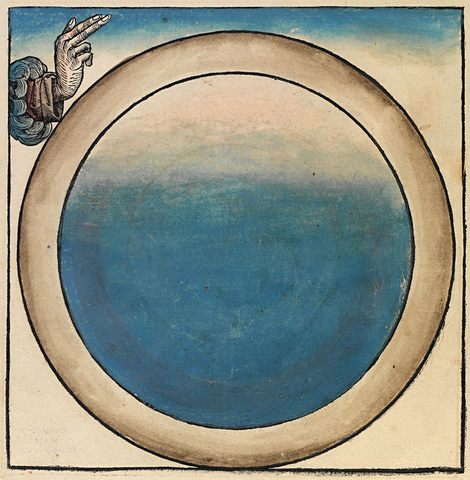
Throughout the development of Science, God has been depicted as either being distant and uninterested in mankind, or if interested, nonetheless distant - because he is transcendent! That simply means he exists outside the universe he created - and importantly - is not subject to its laws. Thus, miracles are not advanced physics, but some form of hocus pocus. In this regime mankind can never really get to KNOW God, because there is no bridge of knowledge between him and us.
You will notice that in such theories, from beginning to end, God is represented as being transcendent. That is, he exists outside of the universe. If this were true: mankind would not be able to understand: either how the universe came to be; nor any of God's personal qualities. But the Bible assures us that both forms of knowledge, are not only attainable for humans, but God wants us to know and use them!:
For God's wrath is being revealed from heaven against all ungodliness and unrighteousness of men who are suppressing the truth in an unrighteous way, because what may be known about God is clearly evident among them, for God made it clear to them. For his invisible qualities are clearly seen from the world's creation onward, because they are perceived by the things made, even his eternal power and Godship, so that they are inexcusable. For although they knew God, they did not glorify him as God nor did they thank him, but they became empty-headed in their reasonings and their senseless hearts became darkenedRo 1:18-21
And all true scientists know this. I will give you just one example now ... but similar quotes from other masters of science can be found throughout this blog:
The prohibition of science would be contrary to the Bible, which in hundreds of places teaches us how the greatness and the glory of God shine forth marvelously in all His works, and is to be read above all in the open book of the heavens" Galileo Galilei
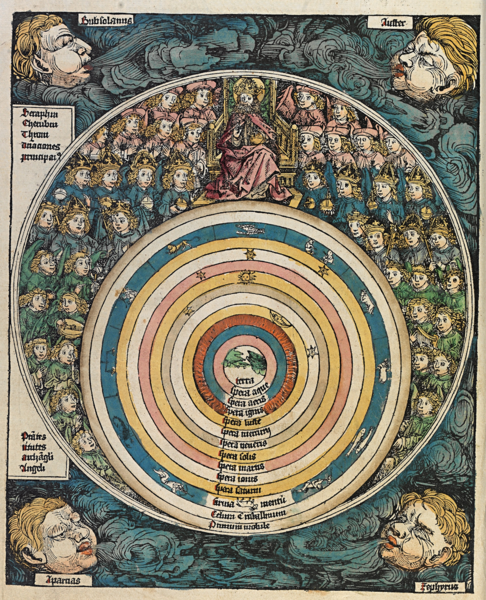
The image in figure 21 is supposed to represent what the universe looked like on day 7 - after God had finished creating everything. The only thing you need to concentrate on to understand what is going on - is the Celestial Sphere! Recall, that people at this point in human history believed that all the stars were the same distance away from the Earth - just in different directions. They believed they were all stuck on the Celestial Sphere at the edge of the universe. Beyond that was the perfect environment where God and the angels lived. The home of the stars - the Celestial Sphere - which acted as the dividing line, was represented by the signs of the zodiac. Thus, the blue layer with the 12 signs of the zodiac represents the Celestial Sphere - the dividing line between the physics of man; and the metaphysics of God!
The truth, I am afraid is much simpler than you have ever imagined. All scientists believe that God exists in the universe. Because, otherwise they would have no reason to expect to be able to make sense of the phenomena they are studying! This was brought out by Paul Davies in the documentary A Privileged Planet. Without this "faith" in the intelligibility of the sciences - no one would bother to put in the effort to investigate nature's mysteries. Here's Davies:
The worldview of the scientist, even the most atheistic scientist: is that essentially of monotheism. It is a belief, which is accepted as [an] article of faith, that the universe is ordered in an intelligible way! Now, you couldn't be a scientist, if you didn't believe these two things. If you didn't think there was an underlying order in nature - you won't to do it, because there's nothing to be found. And if you didn't believe it was intelligible, you'd give up because there's no point if human beings can't come to understand it. But - scientists do, as a matter of faith, accept that the universe is ordered and at least - partially - intelligible to human beings. And that's what underpins the entire scientific enterprise. And, that is, a theological position. It's absolutely clear when you look at history! It comes from that theological worldview. Now, that doesn't mean you have to buy into the religion, or buy into the theology - but it is very, very significant, in historical terms!" Paul Davies | The Privileged Planet - USA Havana (1:04:28-1:05:21)
I trust that you noted that what Davies has just laid out in the above quote is the exact sentiment the Bible made in the book of Romans. Thus, if scientists are not really atheistic, in the way you might imagine the term to be defined (since you can't practice science if you don't believe in God), then what does scientific atheism involve? Again, both Davies and the Bible make it clear. You don't "have to buy into the religion," said Davies, and the Bible made it clear, that "although they knew God, they did not glorify him as God nor did they thank him!" That. Is. What. It. Is. All. About. Trying to deny Jehovah God the credit he deserves for his creative works! (Re 4:11) This transparent motivation is not new! It has been known for a long time. Again, Newton:
Opposition to godliness is atheism in profession and idolatry in practiceSir Isaac Newton
Do you see why I say false religion and false science are two sides of the same coin? We move on.