
More Early 20th Century Progress
Jacobus Kapteyn
Jacobus Cornelius Kapteyn (19 January 1851 - 18 June 1922) was a Dutch astronomer and professor, who had an important impact on our understanding of the universe. The force of his ideas had a great influence on one of his protege's, one Jan Oort, of whom we shall soon learn.

Kapteyn was the first professor of astronomy at the University of Groningen, in the Netherlands. He held the post from 1878 to 1921 when he retired. His love of teaching was extended to all his three children, including two daughters. It was the common belief in Kapteyn's age that girls should not be schooled in mathematics or the sciences. Further, men weren't in the habit of getting involved in child rearing. Kapteyn bucked both trends. He was a loving and attentive father to all his children and made sure his daughters were well trained in the popular subjects of the day. When they were old enough, he enrolled them in a boys school, with their brother. They studied law and medicine in university, no doubt due to the loving attention and encouragement of their father, the Professor
At the start of his career, young Kapteyn lacked the resources to be fully effective at his chosen career. Not having access to an observatory through which he could study the stars, he volunteered and collaborated with David Gill. Sir David Gill, as so many great men of the sciences come to be known, was a Scottish astronomer who had been taught by the great James Clerk Maxwell, and would end up spending much of career, more than 27 years in South Africa. Gill was appointed to work at the Cape Observatory in the late 1870s. The Royal Observatory at the Cape of Good Hope, later renamed to Cape Observatory, was established in 1820 and is the longest running continuously existing scientific institution in South Africa. Over the years of its existence, a small neighbourhood formed around it, which was appropriately named ... Observatory. It was here, that David Gill was conducting his photographic survey of the southern hemisphere. Though Kapteyn was only just starting his career, we rightly call his association with Gill a collaboration due to Kapteyn's measurable contributions to this endeavour. The special tools they used in their measurements included a parallactic instrument that was constructed by Kapteyn, so he was no bystander in the survey. When the survey was completed, it produced a publication known as the Cape Photographic Durchmusterung, an extensive catalogue of the positions and magnitudes of 454 875 stars in the Southern Hemisphere.
It was in 1904, during his studies into the proper motions of stars, that Kapteyn realized that their motion was not random. As the Earth rotates on its axis, we perceive the stars like the sun to rise in the east and set in the west. This nightly uniform motion of the stars, is a consequence of the Earth moving - of course. The proper motion of the stars takes into account that the stars themselves move relative to each other. This motion is incredibly small, but it is there. Just like the moon and the Earth form a gravity bound system, but the moon's position relative to the Earth is dynamic. At some times it is farther from the Earth than at others. When the moon is at the closest point in relation to the Earth it is called a super moon, due to the fact that it appears larger in our night sky and it bathes the Earth with an increased amount of light. The dynamic nature of the Earth moon system, well illustrates the concept of the proper motions of the stars, overall they maintain their relative positions to each other but there is a degree of flex, or dynamic movement. That movement is called a star's proper motion. It was while studying such minute motions, that Kapteyn came to the understanding that star movements are not random, as was the conventional wisdom of the time. Indeed, overturning mankind's conception of the dynamics of galaxies, Kapteyn proved, as Wikipedia documents, that the motion of stars could be divided,
... into two streams, moving in nearly opposite directions. It was later realized that Kapteyn's data had been the first evidence of the rotation of our galaxy, which ultimately led to the finding of galactic rotation by Bertil Lindblad and Jan OortJacobus Kapteyn - Wikipedia
Science has been incorrectly defined in the current age, as content that lives behind a firewall of mathematical competence. Thus most people outsource it to those that they think have such qualifications and thereafter accept all their claims uncritically, as if they were gospel truth. All because of their fear of mathematics. Nothing could further from the truth. Firstly, mathematics is not at all daunting. It is the inferior education systems of our day that alienate people from the wonderful language of mathematics. Everyone wants to learn French, no one wants to touch mathematics. Nevertheless, while mathematics opens up the universe to human reason, human reason can do just fine in many aspects of understanding how the universe functions. A case in point is the simple logic Kapteyn used to figure out the motion of the stars. Like a two-way road: if we stand in the middle, we will see cars moving only in one direction. If we turn a 180 degrees, again the cars are moving in only one direction. This is the perspective of someone who is in the middle of the road. However, an individual standing on the side of the road, will see two-way traffic. They will see cars moving in both directions. At this point everyone thought the Earth was at the center of our galaxy. But the fact that we saw stars in moving in two opposite directions, could only mean one thing. We were not at the center of the galaxy, but somewhere on the side, towards its outer parameters. The wonderful logic of a lucid mind - no mathematics needed.
We have already pointed to the great significance of this achievement in astronomy, and with our last quote we move naturally to our next innovator ...
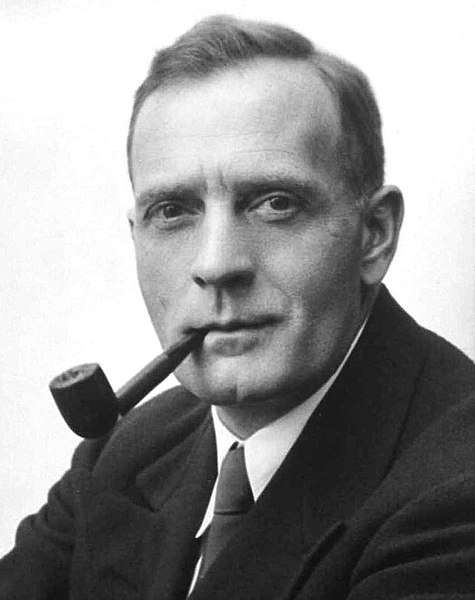
Edwin Hubble
Now that we have covered all the basics, we can return to documenting the history of cosmology. For the twentieth century there is no better place to start than with Edwin Powell Hubble (November 20, 1889 - September 28, 1953). To get us back into the picture, let us quickly review the state of cosmology before Hubble's momentous arrival on the scene. In the early 1900s, the conventional wisdom among all the leading cosmologists was that the universe was contained in the Milky Way galaxy. Humans thought our galaxy was the universe. Hubble's initial accomplishments in this field were to prove that what had been previously thought of clouds of dust and gas, were in fact other galaxies. It is for this reason that he is credited with establishing the filed of extragalactic astronomy, i.e. astronomy that focuses outside our own Milky Way galaxy. Like Clausius before him, Hubble used the discoveries of brilliant scientists before him as his foundation for scaling to exalted levels of new knowledge. He employed Cepheid variables, discovered by Henrietta Swan Leavitt in 1908, to create a scale for the distances of the objects he was studying. In 1919 he started what would prove to be an illustrious, and lifelong tenure, at the Carnegie Institution for Science's Mount Wilson Observatory, which we will simply refer to as the Mount Wilson Observatory. He arrived just in time to be able to start work on the newly installed, state of the art Hooker Telescope, which was then the world's largest. By identifying Cepheid variables in the far distant nebulae, he was able to ascertain from their distances that they were too far away to be part of the Milky Way galaxy! What could such a discovery mean? Hubble was bold enough to follow the data to its logical conclusion. If these stars were too far away to be part of the our galaxy, then the only other possibility was that they were outside our galaxy: the Milky Way was not the only galaxy in the universe! This was 1924, and the scientific establishment was dead set against such a notion. Despite this, Hubble defiantly published his findings and communicated them to other scientists. The effect was ground breaking, but Hubble was only getting started.
After the New York Times had agreed to publish his discovery on 23 November, 1924, Hubble pressed on, and soon had done more for the world's understanding of the universe than anyone else, since Galileo and Newton. He was the first to classify galaxies, formulating a method for how anyone could group galaxies intelligently. This schematic became known as the Hubble sequence. So the universe was bigger, much, much bigger than the Milky Way, but conventional wisdom also understood it to be static. Again, Hubble would introduce a paradigm shift. Meticulous in his nature, Hubble carried out many calculations using his Cepheid variables, among other techniques, and soon had plotted the distances of 24 galaxies outside our own. In a development that would later become known as Hubble's law, he took his own calculations and compared them to the speed at which these galaxies were moving in relation to the Earth - known as their radial velocity(ies). He found two points of interest. First, the galaxies were all moving away from the Earth, and secondly: when he plotted the rate at which they were receding from the Earth, he found that the farther out they were the faster they were moving away. This meant the universe was not static, but dynamic. The figures he came up with have been refined in the almost 100 years, since he discovered this relationship. By current estimates, his figures were 7 times smaller than the distances calculated by today's methodologies. What is important to note, is that they were proportional to the current data. That means, though they were inaccurate by a factor of about 7, the central lesson of their existence is still valid: the universe was undergoing expansion. The "Hubble law" is the principle that defines this rate expansion.
Of more interest was that the relationship he discovered between the distances of the galaxies, and their radial velocities, was linear! This itself was a momentous realization. Why was it significant? A linear relationship between distance and velocity, means if two galaxies are one unit of distance away from each other, the one farther away, will be moving at the rate of one unit of distance away from the Earth. The units are not important, only the understanding of the underlying concept. Continuing on: if a second galaxy were now discovered 5 units of distance away from the Earth, it would be moving away from the Earth not at 1 unit of velocity, but at 5! Put another way, not only was the universe expanding dynamically, but the expansion was accelerating! The consequences of this new understanding were momentous and immediate: clearly if the universe was expanding, it means in at some point in its past, it must have been much much smaller. More importantly, it meant the universe had a beginning! There are a lot of exclamation marks in this paragraph, but they are necessary to communicate the impact of Hubble's discoveries. But not everything was sunshine. For one, there were detractors to Hubble's calculations, who offered other explanations for the redshift of galaxies. Alternatives that didn't depend on an expanding universe, as we will soon see.
With a career spanning the first half of the 20th century, Hubble was like a man trying to find his way in a dark room. Not much was known, but there was endless speculation from his colleagues about the origins of the universe. Personally, he hated speculation and wanted to rely only on observable phenomena and verifiable facts. He wrote two books in 1936: The Observational Approach to Cosmology and The Realm of the Nebulae. As he said in the latter publication, "Not until the empirical resources are exhausted, need we pass on to the dreamy realms of speculation." Wikipedia quotes him as saying: "I am an observer, not a theoretical man." It further quotes the book Edwin Hubble: Mariner of the Nebulae as saying, "His life was dedicated to science and the objective world of phenomena ... science is unconcerned with the transcendent...." That attitude of sticking only to verifiable facts, had a surprising consequence - it put him at odds with his own colleagues in the latter part of his career. You would think all scientists were firmly in the camp of observational evidence over theory, but you would be wrong! Georges Lemaitre proposed the theory of the Big Bang in 1931, and it quickly became the rage of the scientific community. This forced Hubble into a tight corner. Would the avowed observer align himself with an unverified theory? Hubble dedicated 6 years of further study to test its claims and in December of 1941, he submitted his results of observed facts to the American Association for the Advancement of Science. In this report, he showed how empirical evidence did not support the Big Bang theory! He proved, as was reported by the LA Times on December 31 1941, under the subheading, Theory Refuted that: "The nebulae could not be uniformly distributed, as the telescope shows they are, and still fit the explosion idea." What's more, the Earth is at the center of the distribution of galaxies, meaning the Earth had to be older than any expansion as its position was not affected by it! Further, not being affected by the cause of any expansion means its cause, could not be an explosion. For those affect everything around them. For these reasons, Hubble refuted the Big Bang theory. In his own words, the LA Times quotes him as saying, "Explanations which try to get around what the great telescope sees ... fail to stand up. The explosion for example would have had to start long after the Earth was created, and possibly even after the first life appeared here." In their models scientists, estimate the Earth to be about 4.5 billion years old. Hubble calculated the expansion of the universe, free from a Big Bang explosion, as occurring 2 billion years ago. This calculation, is what is now known as the Hubble constant - The rate at which the universe is estimated to expand. We take note, not of the speculative time-frames, but of the relationship, that is, the ratio of time between the two events occurring.
Jan Oort
When your New York Times obituary claims that you are: "one of the century's foremost explorers of the universe," and the claim is true! Then you know you have done something right in your professional career. Jan Hendrik Oort (28 April 1900 - 5 November 1992) achieved great things in his life, and he was right honoured for his amazing accomplishments, with structure such the gigantic Oort cloud, at the edge of our solar system being named so, in his honour. Among the many discoveries made by this Dutch astronomer, are the fact that the Milky Way rotates. He was on of the first to postulate the existence of dark matter, a year before Zwicky, with Wikipedia explaining,
He also postulated the existence of the mysterious invisible dark matter in 1932, which is believed to make up roughly 84.5% of the total matter in the Universe and whose gravitational pull causes "the clustering of stars into galaxies and galaxies into connecting strings of galaxies" Jan Oort - Wikipedia
That description is important. Keep in the back of your mind, we will have use for it later. Oort is also the man who thought deeply about the nature and implications of comets. This led him to valuable insights, such as the fact that their elongated orbits meant that they came from a quite a distance beyond where the planets of our solar system reside. Hence, since they were a part of our solar system, but had a range of motion that far exceeded the distances of the planets, it must mean that the solar system itself is far vaster than just the region occupied by planets. This conjecture was proven to be true, with the region of our solar system where his eponymous Oort cloud being estimated to reside between 2 000 to 200 000 astronomical units away from the Sun, according to Wikipedia. That's 2 000 to 200 000 times the distance between the Sun and the Earth! Additionally, and most importantly for us, he discovered the galactic halo! However, this discovery is not of any importance in itself, what makes it relevant to our discussion is the reasoning he used in figuring this important fact about star systems!
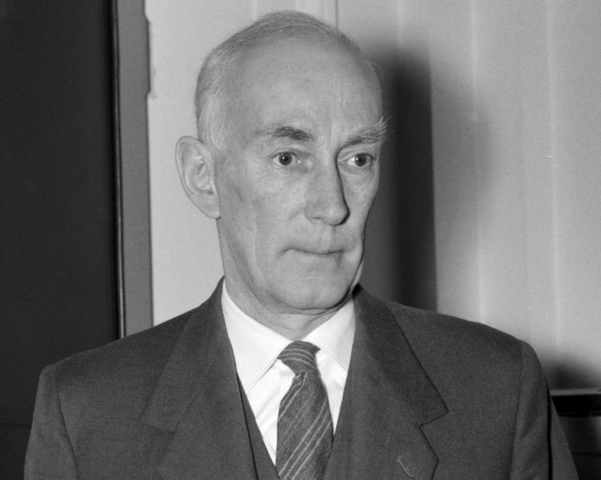
Even in this picture, you can see evidence of the clear focused mind of Jan Oort. Being a student of Professor Kapteyn, Oort benefitted from the professors vast research into the motions and structure of the universe. Oort put all the details together into a coherent whole. He was at the right place at the right time to be able to establish and prove the reality of galactic rotation.
In 1926, following the work of Swedish astronomer, Bertil Lindblad that asserted that the rate of rotation of the stars in the outer part of galaxies decreased with distance from the core. In other words, the stars near the center of a galaxy rotate faster than the stars at its outer edge - its periphery. Oort was immediately taken by this idea, noting that this was a truth that could be proven observationally . Thus he firmly established this principle by providing formulae that mathematically described such galactic rotation. In expanding on these facts, Oort argued that the dynamics of the outer stars relative to the inner ones would follow the same patter observed of the outer planets in our solar system relative to the inner ones: that is, as he put it, in a quote from the Oxford Dictionary of Scientists, which is in turn included in his Wikipedia article:
just as the outer planets appear to us to be overtaken and passed by the less distant ones in the solar system, so too with the stars if the Galaxy really rotatedJan Oort - Oxford Dictionary of Scientists
Such descriptions of his process, miss the mark though, for they do not highlight the essence of this discovery. Before Oort, no one could prove where the Earth was located within the Milky Way galaxy. The problem was not a trivial one, for the answer held great significance for our ability to understand the structure of the universe as a whole. In his deep dive studies of the rotations of stars Oort came the realization that the movement of the stars in a plane could tell us much about the position of the observer! As Wikipedia, all too nonchalantly says,
Oort determined that the Milky Way rotates and overturned the idea that the Sun was at its centerJan Oort - Wikipedia
Such glossing over important details will not do. It is precisely the details of how he proved that the sun, and hence we, are not at the center of the solar system, that is of interest to us.
As a precursor to talking about Oort's logic, we must quickly refer to the discovery that the stars do not move indiscriminantly, but that they all follow a general direction, like water moving in a circle around a drain. With that in mind, we now think of a two way road with one lane running in each direction. This mimics the general one-way movements of stars within a galaxy, for each lane can only move in its prescribed direction, and no cars will be allowed to move in the opposite direction. Taking our example further, we think of an observer standing at two different locations with regard to the flow of cars. In one scenario, our bystander is standing by the side of the road and can see both lanes of traffic with cars going in each of the two different directions. In the second scenario, our bystander is standing in the middle or the road. What will she see now? She will only be able to see the cars in front of her. Lets say our bystander is in a right hand drive country, where the cars have their steering wheels on the right side and thus drive on the left side of the road. In such a case, the cars will be traveling from left to right, no matter which lane she is observing. Once again, if she is standing in the middle of the road, she will see one set of cars traveling from left to right. If she turns around by 180 degrees, she will see the cars from the lane, but again, they will be traveling from left to right. Now that we have considered both scenarios, let us consider their significance. When our observer is standing in the middle of her environment, she sees only one way traffic, when she is standing at the edge of her environment - at the side of the road - she observes both lanes, and sees two streams of vehicles traveling in opposite directions. Now we apply these dynamics to galactic motion, and what it means about the location of the observer within that environment.
When Oort studied galactic rotation and the movements of stars within the Milky Way galaxy, he noticed that the stars within the Earth's line of sight consisted of stars traveling in two opposing directions! Since, scientists already knew that this was not due to stars having irregular motion, as it had already been shown that all the stars within a galaxy move in the same direction. Thus the only conclusion that can be drawn from entities that flow in one direction being observed to move in two different directions, is that the observer must be at the edge of that environment: they are standing ont the side of the road not in the middle, to put in terms of our earlier traffic example. It was that ingenious insight from Oort that allowed humans to understand that the sun and hence, us and our solar system where not in the middle of the Milky Way, but somewhere towards its outer limits. After Oort, other luminaries appeared who further refined our understanding of our location within the Milky Way, and the true nature of the universe and our place in it.
EXPLANATORY NOTE:
The difference between these two illustrations is immense. It takes the pioneering work of Kapteyn and melds it into a coherent picture of what is happening - and, of where we fit into our galaxy. Oort was able to logically work out what the fact that from Earth's position we can see both streams of oppositely traveling stars meant! It meant we were not at the galactic center, but somewhere near its outer peripheries! Compare the above illustration, with the one below and note that it is impossible from the Earth (in above illustration), to see opposing streams of stars - at the same time! While with Earth's revised position (as illustrated below). It is not possible to not see such movement!
EXPLANATORY NOTE:
How does the position affect what we see, in practical terms? The stars in spiral galaxies, such as the Milky Way, are arranged in what are called spurs. That is the curved, crescent-like shape you see in the illustrations above. Each illustration has four spurs. When you are in the center you can never see the whole curve of the spur. However, when you are on the side, you see the whole spur. The two streams of stars traveling in opposite directions are different parts of the same spur! If you shape your hand into a 'C' shape and twist at (like you're opening a bottle), you will see that your thumb moves in an opposite direction to your fingers. In this case your c-shaped hand is a spur. And that is the same dynamic we see with the galactic spurs.
Fritz Zwicky
In 1933 while Fritz Zwicky was studying the Coma Cluster, he noticed that the galaxies in cluster were moving much too fast for the amount of mass that they contained. He correctly surmised that there was more matter in the Coma Cluster than was visible. He named the unseen matter dunklematerie - dark matter. However, Zwicky was wrong about everything else. Zwicky meant the term quite literally, that is he thought there was matter that was dark. Matter that couldn't be seen from Earth because it doesn't emit enough light. He did not arrive at the correct conclusion that the substance was invisible! He assumed - without any evidence - that the unseen dark matter was cold diffuse gas. In his description of dark matter, many dim objects in the universe could fit his definition. The mass distribution in his model of the universe had about 1.5% stars, planets and all other physical bodies such as comets etc. The rest of the mass in his mind was made from gas clouds. As Nick Lucid, from the Science Asylum YouTube channel points out: "He was making claims, he didn't have enough evidence for. That's bad science. Zwicky had the right idea but for the wrong reasons!" The only reason we include him in the chronology of scientists who contributed to the database of astronomical knowledge is because he coined the term, but did not discover the phenomenon of dark matter!

Just like the early fathers of Science, men like Copernicus, Kepler, Galileo, Newton and Boyle - among many others - were devout Christians who believed God created the universe, and that facts, logic and experiment could prove as much, Fritz Zwicky, was a devout atheist. This photo belies the nature of his character. He had an engaging personality that could easily rub people the wrong way. He is the only scientist whose Wikipedia profile describes him as a "curmudgeon." That unflattering term is defined as an: "ill-tempered person full of resentment and stubborn notions," as per the Wordnik online dictionary.
Fritz Zwicky
Fritz Zwicky (14 February, 1898 - 8 February, 1974) was a brash, loud, free thinker who was anything but shy. He was a devout atheist, who was unafraid to make his opinions known. Wikipedia summarizes his persona in the following way,
He is remembered as both a genius and a curmudgeonFritz Zwicky - Wikipedia
The article goes so far as to announce that he had favourite insults, that he crankily directed at his fellow scientists! Despite his in-your-face personality, he had many scientific accomplishments. The three, we are interested in, are his 1933 insight that the universe contains unseen matter, which he called dunkle materie, or dark matter; his 1937 theory that gravitational lensing, could be applied to galaxies; and his proper reasoning, but incorrect solution to his objection against the calculations of Hubble's linear relationship between the distance of galaxies and the velocity of their redshifts. Gravitational lensing was idea introduced by Einstein and came naturally from his earlier prediction that light rays would be bent in the strong gravitational field of the sun. We recall that Arthur Eddington verified as much in 1919 with his mission to study such light rays, from distant stars, during the solar eclipse of that same year. as it relates to the other heavenly bodies apart from the sun, gravitational lensing is defined by the following scenario: light from a distant source is bent due to the curvature of space around a massive object that lies between the distant light source and us, here on Earth. Einstein had had the idea from as early as 1912, but disregarded it, as the possibility that two stars would be so aligned with respect to observers on the Earth was highly unlikely, and moreover, he felt that distant stars were not bright enough, for their images to observable on Earth.
Gravitational Lensing
Over the intervening years, many different scientists toyed with the idea, but two hurdles always lay in their way: distant stars weren't a strong enough light source for such an effect to be observable on Earth, and individual stars are highly unlikely to be in each other's lines of sight with respect to the Earth, as the universe is very large and stars have vast spaces between them. It was this idea that Zwicky applied to galaxies, instead of individual stars, after Hubble had proven that the nebulae of the past, were actually, other galaxies, that were extremely distant from our own. Galaxies are obviously much bigger than stars, and with this new tool in the toolbox, Zwicky realized that the probability of two galaxies being in the same line of sight with the Earth, was much higher than it was for stars. Further since galaxies are so much brighter than stars, the second objection was also overcome: and so Zwicky boldly made his prediction in 1937. This quote from einstein-online.info, summarizes the point:
The typical masses, sizes and mutual distances of galaxies are such that double images of a distant galaxy should be significantly more frequent than double images of stars: The necessary near-alignment of a closer object, a more distant object and an observer here on Earth is much more probable for galaxies than for stars" Fritz Zwicky
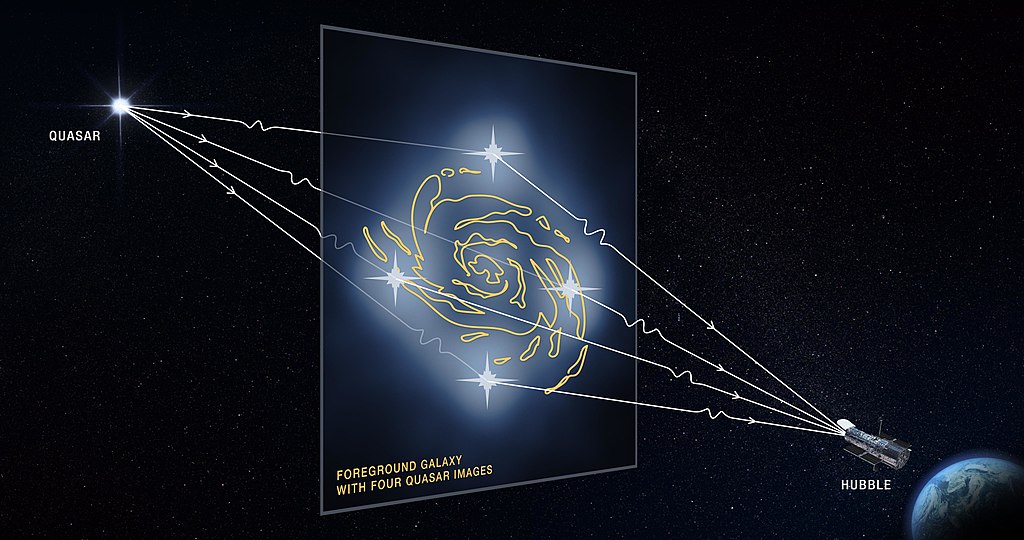
Wikipedia explains it in its own, slightly more detailed way,
A gravitational lens is a distribution of matter (such as a cluster of galaxies) between a distant light source and an observer, that is capable of bending the light from the source as the light travels toward the observer. This effect is known as gravitational lensing, and the amount of bending is one of the predictions of Albert Einstein's general theory of relativity. Treating light as corpuscles travelling at the speed of light, Newtonian physics also predicts the bending of light, but only half of that predicted by general relativity" Gravitational Lens - Wikipedia
Zwicky, would have to wait more than four decades, as gravitational lenses were first detected, only in 1979 by Dennis Walsh, Robert F Carswell and Ray J Weymann, when they detected the double quasar Q0957+561. It appeared as a double image of the same stellar object. Having verified the technique with the use of galaxies, discoveries of gravitational lenses throughout the universe, soon became commonplace, as other scientists learned to detect and routinely discover such multiple or distorted images in our night sky.
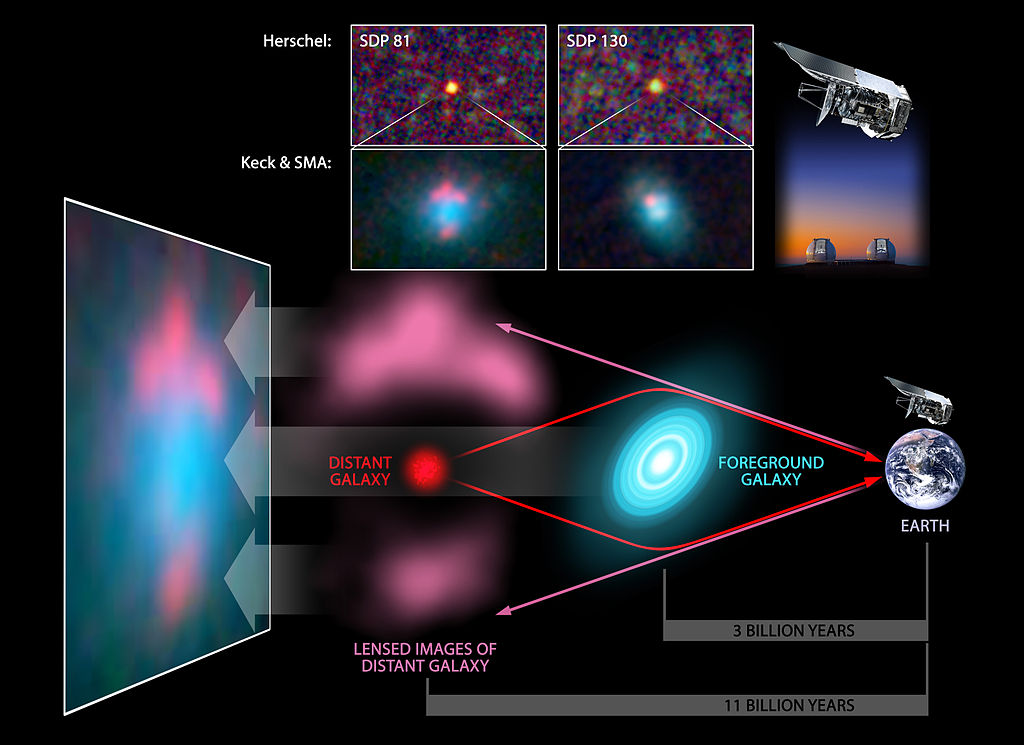
As Zwicky correctly predicted, it is much easier to spot a gravitationally lensed galaxy, than it is to spot a star. This is simply due to brightness and size. Thus, while theoretically, both can be gravitationally lensed, in practical terms, most detected gravitationally lensed objects are galaxies - not stars. That is the difference between Figure 65 above, and Figure 66 to the left.
A last word from einstein-online.info on the utility of gravitational lensing and its applications in the current scientific environment:
The reason for the field’s growth is that, today, gravitational lenses are much more than just an interesting general relativistic phenomenon. Now that a significant number of lens systems has been identified, lensing is used more and more as an observation tool, allowing astronomers to answer astrophysical as well as cosmological questions, from estimates of the amount of dark matter contained in the lens mass to the determination of fundamental parameters of the big bang models"
An Introduction to "Dunkle Materie"
That bring us to the second of Zwicky's proposals, that is of interest to us: 'dunkle materie' - dark matter! Gravitational force, is of course, a consequence of the amount of matter within a gravitational field. That's why the moon has less gravitational force than the Earth, because it is smaller than the Earth. Zwicky was the first to notice that, as respects galaxies, there was a mismatch, between the amount of stars in the newly discovered galaxies and the rate at which the galaxies rotated, which in turn, is a function of their gravitational mass. Somehow, as it applied to galaxies, these normally correlated factors were not in sync. The galaxies were rotating much too quickly, for the amount of stars within their galactic discs. Zwicky's proposal for the solution was that there was a large mass of matter that somehow couldn't be seen! Dunkle materie! Zwicky was not the first to make this suggestion, with pioneers such as Lord Kelvin suggesting such a possibility from as early as 1884. In the years between, men such as Henri Poincare, Jacobus Kapteyn, Knut Lundmark and Jan Oort all proposed some sort of 'dark matter,' and all for similar reasons. Nor was Zwicky the person who empirically established the existence of dark matter, that great honour goes to Vera Rubin, of whom we shall soon learn. Zwicky calculated a gravitational mass of 400 times higher than what could be seen. As mentioned earlier, instruments and techniques improve and the current estimates about six times more mass than can be seen. Nevertheless, Zwicky's intuition was correct, if not precise.
The Death of the "Tired Light" Hypothesis
Lastly, we deal with the third of Zwicky's accomplishments, that are of interest to our discussion: the explanation for cosmological redshifts. As stated above, all scientific measurements have a margin of error associated with them, and that margin decreases with time. Recall, that we said Hubble's initial estimates for the distances of his Cepheid variables, were later revised to be 7 times greater than his initial measurements. Before, the instruments used for measuring such distances were refined, Zwicky carefully studied Hubble's analytical data of his findings and noticed a discrepancy in the correlation between Hubble's calculated distances for galaxies and their redshifts - the discrepancy was too large, much larger than allowed by the margin of error for Hubble's distance calculations. The ready explanation floating around scientific circles was that space had expanded. Zwicky took such an explanation under consideration, but rejected it along with some other alternatives. Again, Wikipedia clarifies the reasons for his aversion to such explanations:
Zwicky was skeptical of the expansion of space in 1929, because the rates measured at that time seemed too large. It was not until 1956 that Walter Baade corrected the distance scale based on Cepheid variable stars, and ushered in the first accurate measures of the expansion rate. Cosmological redshift is now conventionally understood to be a consequence of the expansion of space; a feature of Big Bang cosmology" Tired Light - Wikipedia
At the time he proposed his Tired Light hypothesis, the data didn't favour any one theory over another, but since then observational evidence has rendered his position obsolete. A Wikipedia quote summarizes developments,
Additionally, the surface brightness of galaxies ... and a thermal spectrum of the cosmic microwave background have been observed — these effects should not be present if the cosmological redshift was due to any tired light scattering mechanism. Despite periodic re-examination of the concept, tired light has not been supported by observational tests and remains a fringe topic in astrophysics" Tired Light - Wikipedia
To clarify that last quote, the cosmic microwave background lies behind all the stars, so if the stars have lost their energy due to Zwicky's reasoning, then the thermal spectrum of the CMB which is originates from much, much farther away should not exist. The fact that it does means there is no mysterious mechanism that saps the energy out of light rays as they travel through space.