
The Greatest Null Result in the History of Experimental Science
Unfalsifiable? Albert Abraham Michelson & Edward Williams Morley
The Mount Wilson Observatory, was a hive of scientific activity as soon as it was launched. Scientists clamoured to get access to this leading technological masterpiece to advance their research. One such man was an accomplished German-born American scientist named Albert Abraham Michelson (19 December 1852 - 9 May 1931). Winner of the Nobel Prize in Physics for 1907 - the first American to win a science based Nobel Prize: Michelson was a big deal. Michelson was a man obsessed with light from early in his career. By the time he planned a detailed measurement of it from Mount Wilson Observatory in the early 1920s, he had already measured and published results twice for the speed of light. Michelson, ever diligent, kept refining his methods and in 1926, after a laborious process of ensuring the highest standards and precision for his measurement were followed, Michelson again published his latest findings for the speed of light: 299 796 +- 4 km/s. Towards the end of the 1920s, new methods for measuring the speed of light emerged, using recently developed electro-optic devices. The teams that produced these results, all had measurements that were lower than Michelson. Michelson got to work. One way to refine his approach he theorized, was to perform the measurements in conditions that were as close as possible to a vacuum. That way, many of the factors that cause errors could be avoided. Thus in 1929, he began another collaboration, this time with Francis G Pease and Fred Pearson. The details of the approach are not important. What interest us is the persistent and willing collaborative spirit of Michelson. These features of his personality were consistent threads throughout his long scientific career. This collaboration yielded results that had never before been obtained, and Michelson died before they could be published nevertheless, his indomitable spirit bore testament to his unfailing love for science and his eagerness to provide proof for his most deeply held beliefs.
Having come to understand a little bit about the personality of Michelson, we will now consider another of his lifelong pursuits. One that is closely related to his love of light, and that culminated, in an experiment he conducted with one of his colleagues at Case Western University, Edward Williams Morley. The infamous experiment was known as the Michelson-Morley interferometry experiment, and its purpose was to confirm the existence of the substance that light used as a medium to travel from one location to another in space. Newton had said that there were no ether like mediums filling space, more than two hundred prior to Michelson. But Michelson - thinking he could take on the great mind of Newton - was firm in his opinion that light needed a medium to propagate and it was his aim to prove the existence of this medium. His ideology was based on ideas that, as we know, originated in ancient Greece, of a universal aether that was thought of as the fifth element, holy - the so-called Luminiferous Aether! It is of the greatest importance to highlight that at the turn of the 19th century, and beginning of the 20th century, many in the scientific community had the feeling that science had accomplished all that was to accomplish, knowledge-wise. It was felt by many, that everything was known about the world and how nature works, and that the little odds and ends that were left to be solved, would be dispensed with easily and imminently. This pervasive opinion about the state of human knowledge was shared Michelson, who famously remarked that,
The most important fundamental laws and facts of physical science have all been discovered,and these are now so firmly established that the possibility of their ever being supplemented in consequence of new discoveries is exceedingly remote" Albert A Michelson
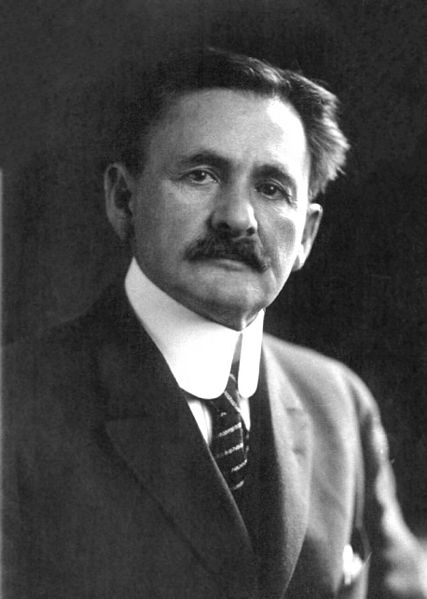
Albert Michelson was a Nobel prize winner. So, we know he was not without talent. However, he lacked the first and foremost gift, the one that is the foundation of all true scientific inquiry - scepticism. An interesting quote from Michael Jordaan, is "," the equivalent sentiment from Naval Ravikant is, "There difference between sounding smart, and being smart is 'I don't know.'" Albert A Michelson knew! This sure-footed sense of knowing something absolutely was on full display, when an experiment he himself designed and conducted produced a null result, repudiating the theory it was supposed to establish. But Michelson knew too much to be told he was wrong, even when the bearer of such news, were empirical facts!
Rarely has a scientific statesman being more wrong. For such reasons, in their minds the purpose of any further scientific investigations was not to discover new knowledge, but to confirm experimentally what was already believed by the vast majority of the scientific community. It was with this attitude that Michelson and Morley attacked their challenge - to try and definitively prove the existence of the aether. The term "Luminiferous aether", was coined by Christiaan Huygens, another firm believer in the aether in 1690, almost 200 years before the Michelson-Morley experiment. It means light bearing aether. In this instance, the ether was not the heat bearing fluid, that Lavoisier had conjured up to explain the dynamics of heat. No it had morphed back to its most original form, as Matt O'Dowd explains, the aether was:
... The invisible, all pervasive medium through which light was thought to propagate.Matt O'Dowd - PBS Space Time
... It was the immutable and indestructible element that filled space and in crystalline state formed celestial bodies.... aether is the fifth element! Medieval alchemists were all about the aether .... They believed this spiritually pure element had miraculous capabilities of transmutation.... Fast forward to the mid seventeenth century, French philosopher Rene Descartes asserted that there could be no such thing as empty space, and Aristotle's aether therefore both filled and gave reality to the space between celestial bodies, He imagined the aether as flowing, moving in vortices. These flows carried the celestial bodies, for example: in circles around the Sun." Albert A Michelson
It what has been called the "the most famous null result in the history of physics,"* (How Luminiferous Aether Led to Relativity - @11:07) Michelson and Morley failed spectacularly in their quest to furnish prove for the aether!
It seems probable that most of the grand underlying principles have been firmly established and that further advances are to be sought chiefly in the rigorous application of these principles to all the phenomena which come under our notice" Albert A Michelson
The most perplexing thing about the second of Michelson's quotes is that he made it 1894, seven years after his failed experiment should have humbled him, and made him realize that science was only at the beginning of its long and never ending quest to gain knowledge about the universe. The reason for Michelson to attempt his experiment was to bring an old and heated debate to a conclusive end. It's most highly publicized protagonists were Huygens and Newton - for very different reasons. Whilst Huygens asserted his own "wavefront" theory, Newton, who had initially believed in the aether as it was conventional wisdom for his time, upon thinking about its consequences decided it could not exist. Newton's objection was that if an aether existed it would retard the earth's and all other planetary motion around the sun. Just like walking in water is more difficult than walking in air. Thinking of our water analogy, when you move your hand in water, the water behind your hand moves differently to the water in front of your hand, and it was this difference that the Michelson-Morley experiment sought to detect and quantify. Finally, there would empirical evidence for the existence of one of the oldest and most persistent ideas in science. Indeed the luminiferous aether, had its inception pre-science, in what can only be called the mythology of the ancient world. A secondary part of the arguments was that Newton believed light to be made of particles, what he called "corpuscles." The online Wordnik dictionary defines corpuscles as: "A discrete particle, such as a photon or an electron." Of course a photon is a particle of light, so we know that Newton was right, but in this case Huygens was also right, since light is also a wave and displays both a wave-like and particle-like duality. The fact that light behaves as a wave was confirmed in the double slit experiment, by our old friend Thomas Young, whom we came across when we studied 'energy,' for he coined the term. The result of the double slit experiment was that light exhibits refraction and interference patterns, and refraction and interference patterns are part of the evidence profile for waves, not particles. More than that Maxwell's equations had also predicted that electromagnetic waves travel at the speed of light. That is why currently light is called an electromagnetic wave. And the spectrum of light: from the high energy gamma rays, all the way down to low energy x-rays, is called the electromagnetic spectrum. Recall, though that this evidence came after Newton and Huygens had squared off, and many decades before the evidence for light as a wave would surface in the early 1900s. So at the time of the Michelson-Morley experiment, they must have been completely convinced that light was a wave, and that, since all waves need a medium to travel, their job - their only job - was to furnish the proof of the existence of that medium: the legendary luminiferous aether! Can you sense the excitement, the anticipation of a successful conclusion to their quest? As O'Dowd puts it: "The reality of the luminiferous aether seemed a done deal.... And so we get to the end of the nineteenth century ... physics seemed pretty much wrapped up. Albert Michelson and Edward Morley thought they'd help tie a bow on it by demonstrating the existence of the luminiferous aether as a classical medium for the propagation of light."* (How Luminiferous Aether Led to Relativity - From 6:18 to 6:42)
The technique Michelson and Morley used to measure the drag that the luminiferous aether impeded the motion of the earth by in unimportant. What is of value, is that the experiment itself was so ingenious in its concept and execution that the results - whatever they were - would leave no doubt as to who was right Newton or Huygens. The outcome would rule decisively with one of the two camps: either there was no such thing as an aether; or, the ancients were right after all and the luminiferous aether would be established by facts to exist. The stakes couldn't have been higher! For the consequences were not the victory of one scientific theory over another, but a the affirmation of one worldview over another.
The Desperate Meaning BEHIND Etherism & Idolatry
It's 1877. So undeniable was the conclusion of the Michelson-Morley experiment, that Wikipedia states: "... the experiment is today considered the canonical experiment in regards to showing the lack of a detectable aether." The longest standing myth in the sciences was finally dead! Or, was it?
Again, we ask: since, the universal ether theory was so thoroughly disproven by the Michelson-Morley experiment, why was electromagnetism not re-calibrated to what it was pre Maxwell, and his preferred theories that, in his own words, went in "another direction" to the one laid down by the men who discovered the laws of electrodynamics? What is the draw in science for scientists to always invoke the ether? From Aristotle, and down through the ages, scientists have hankered after the ether. When it is disproven in one context, they merely reinvent it in another guise, like Madonna projecting a new look with each new album. Intellectuals at the peak of their powers, will never divulge the reason. But, as some get older they abandon the circumspection, they had earlier in life. One such man is Nikola Tesla. Near the end of his life, he wrote in detail about what the ether represents to the scientific community. His thoughts are captured for us by noted science journalist of the early 1900s, John J O'Neill, in his 1944 biography of Tesla, entitled PRODIGAL GENIUS: The Life of Nikola Tesla, (highlighting is my own, to make the crux of the matter clearer):
Having endorsed, finally, the belief that man will be able to smash, transmute, create or destroy atoms, and control vast amounts of energy, he waxed poetic on the subject. He extended man's control over atoms and energy to a cosmic scale, and saw him shaping the universe according to our desires. In an unpublished article, entitled "Man's Greatest Achievement,'' he wrote: There manifests itself in the fully developed being-Man-a desire mysterious, inscrutable and irresistible: to imitate nature, to create, to work himself the wonders he perceives. Inspired to this task he searches, discovers and invents, designs and constructs, and covers with monuments of beauty, grandeur and awe, the star of his birth. He descends into the bowels of the globe to bring forth its hidden treasures and to unlock its immense imprisoned energies for his use. He invades the dark depths of the ocean and the azure regions of the sky. He peers into the innermost nooks and recesses of molecular structure and lays bare to his gaze worlds infinitely remote. He subdues and puts to his service the fierce, devastating spark of Prometheus, the titanic forces of the waterfall, the wind and the tide. He tames the thundering bolt of Jove and annihilates time and space. He makes the great Sun itself his obedient toiling slave. Such is his power and might that the heavens reverberate and the whole earth trembles by the mere sound of his voice. What has the future in store for this strange being, born of a breath, of perishable tissue, yet immortal, with his powers fearful and divine? What magic will be wrought by him in the end? What is to be his greatest deed, his crowning achievement? Long ago he recognized that all perceptible matter comes from a primary substance, or a tenuity beyond conception, filling all space, the Akasa or luminiferous ether .... The primary substance, thrown into infinitesimal whirls of prodigious velocity, becomes gross matter; the force subsiding, the motion ceases and matter disappears, reverting to the primary substance. Can Man control this grandest, most awe-inspiring of all processes in nature? Can he harness her inexhaustible energies to perform all their functions at his bidding, more still cause them to operate simply by the force of his will? If he could do this, he would have powers almost unlimited and supernatural. At his command, with but a slight effort on his part, old worlds would disappear and new ones of his planning would spring into being. He could fix, solidify and preserve the ethereal shapes of his imagining, the fleeting visions of his dreams. He could express all the creations of his mind on any scale, in forms concrete and imperishable. He could alter the size of this planet, control its seasons, guide it along any path he might choose through the depths of the Universe. He could cause planets to collide and produce his suns and stars, his heat and light. He could originate and develop life in all its infinite forms. To create and to annihilate material substance, cause it to aggregate in forms according to his desire, would be the supreme manifestation of the power of Man's mind, his most complete triumph over the physical world, his crowning achievement, which would place him beside his Creator, make him fulfill his ultimate destiny. Tesla, in his eighties, was still manifesting the superman complex, and on even more elaborate a scale than when in his twenties. In his earlier dreams his visions were terrestrial, but in later life they were extended to embrace the entire universe. Even on the cosmic scale, however, Tesla spoke in terms of matter and energy. These two entities, according to his reasoning, were sufficient to explain all observed phenomena, a situation which militated against the discovery of any new agenciesJohn J O'Neill on Nikola Tesla
When you consider that the words of Tesla are an Evidence Profile for a belief system, it becomes clear, that there is no difference between Etherists and Idolators. Idolatry is seeking to accomplish, exactly the same outcome as false religion, and through the same means - independence from God, through mastery of and over his creation! Idolators believe that devotion to their idol will allow them to live their lives as they wish. They believe that through science and technology - as represented by fire and all the technologies that came after it - they can determine their own futures and achieve mastery over their environments, and indeed, over time - mastery over all reality! Have you never heard Michio Kaku waxing lyrical about type 1, 2, and 3 civilizations? Based on a 1964 idea from Russian astrophysicist, Nikolai Kardashev, this theory, known as the Kardashev Scale, grades the progress of a civilization on its ability to harness and master power from its environment. Essentially, the only difference in pecking order of these civilizations is the entities which they use as their sources of power. We will not expand on this useless scientific theory. The point of mentioning it, was to highlight the vital role energy sources, and humanity's mastery over them, play in the minds of scientists, wanting to be independent of God, and the secular non-scientists - the larger society - who believe wholeheartedly in Scientism! Of course, it goes without saying that the ultimate energy resource is ... The ETHER. Hence, the undying devotion lavished on it from all who believe in it, within the scientific community. Similarly, the whole foundation for Tesla's theory is that climbing the ladder of mastery over the universe, is dependent on achieving mastery over the elements. Learning to harness the power inherent in nature and employ it to further humanity's goals. In other words, two goals: 1) achieve independence from God by securing an energy source to sustain life; then, 2) use secured energy resources to fuel technology that allows humans to gain mastery and thus control, over the human condition: thus eradicating aging, sickness, poverty, crime etc. This is the grand overarching theme of all forms of idolatry ... and the firm, unceasing, and continual quest for a universal ether: the Luminiferous Ether! Shame!
The Evidence Profile for Etherists/Idolators has four components: 1) belief without proof; 2) the empty belief system, can always be traced back to a delusional human theory, that is, it is never a principle found in nature; 3) this false basis for scientific knowledge, always has myriad inconsistencies. The inconsistencies do not initially appear to be such. They are often very well crafted, to the point that they can only ever be falsified, after many years, once empirical data has been discovered. For instance, when Artemis was worshipped in the ancient city of Ephesus, people believed her statue fell from heaven. Today, of course, that could easily be falsified as testing what materials the statue was made from, and then calculating if such a statue of that size, with those material(s), could survive a fall from outer space, as one example; 4) To be long-lasting, false stories must be well crafted, but no matter how well crafted, all lies eventually get overturned by new knowledge. At this point, the adherents to outdated claims begin to offer fixes to their obsolete theories. We saw as much with the Earth-centered geocentric model of the World, when it came to innovations of Copernicus and the irrefutable discoveries of Galileo. We again saw similar behaviour when Phlogiston theory became outdated, and its adherents offered complicated patches in an effort to salvage it, in the face of the quickly developing 'chemistry' model with its periodic table of elements. Again, when the supposed perfect heavenly spheres, which we were told, are holding up celestial bodies in place and transporting them in their orbits, were falsified by Galileo's findings and Newton's mathematical description of gravity - their adherents ran away from the evidence in panic. In each of these and all other cases, the believers in the outgoing model cling desperately to their outdated versions of reality - usually, because that is the source of their living. Instead, they offer endless and complicated revisions to the original idea - to no avail. The data is in! The time for the falsification of such ideas has come. In the Bible this part of false worship is known as: "... [fastening] with nails" so that the man-mande idol "will not topple over." (Isa 41:7) The better a job, the craftsmen does with the original idol, the longer it can last as a lie. But the key is that they are all fastened with nails! For they cannot maintain balance on their own! Once you know this secret, the only thing you have to look for in a failing model of reality - are the nails! Familiarize yourself with this Evidence Profile, as you will see over and over again from now on - until the end ....
F = C q1q2 / r2
Where 'C' multiplied by the value of two charges, with q1 representing one charge and q2 being the second one, divided by the value of the distance between them, multiplied by itself - r squared, or r2. You will not fail to spot the dramatic similarities between Coulomb's equation for the electric force and Newton's equation for the force of gravity, restated below for your benefit:
g = G m1m2 / r2
Where, G is the gravitational constant; m1 is the mass of the first object and m2 is the mass of the second object, and r2 is the distance between the centers of the two masses multiplied by itself. What are to make of two different entities that seem to take the same form, if not share the exact same Evidence Profile? More on that later! In the meantime, we turn our minds back to Weber and kohrausch. What did their experiments mean? Simply that they had managed to "experimentally connected the units of electricity, to the units of magnetism."
The measurement associated with electrical fields is called Permittivity of free space, whilst its companion, which is related to magnetism is called thePermeability of free space. Mathematically, they also have symbolic names: Epsilon naught. The naughts after the Greek names, refer to space being empty, that is a vacuum, with no molecules such as interstellar space. This is represented mathematically, by the '0' after the Greek letters. So these values are the values for electrical and magnetic fields in a vacuum! Hence, the permittivity and permeability of free space are defined as properties of Space. What is important for our consideration is: what do these numbers represent, and how exactly, are they related to electromagnetism and light? These two constants of nature represent how easily electric and magnetic fields permeate through empty space. Next comes the interesting part. When Weber and Kohlrausch published their paper, they showed definitively that these two constants in turn produced a third constant. This team found that the square root of 1 over the product of permittivity and permeability equaled a number they had never seen before 310 000 000.
Weber and Kohlrausch, worked diligently to both unify the growing body of electromagnetic laws into a unified theory of electromagnetism, and to assimilate their own findings into such an unified theory. Prior to Weber's successful efforts starting in 1846, other scientists had made great strides in one or other aspect of the field of electrodynamics. The problem is their results were siloed, contained in what seemed to be unrelated domains, and if there was some overlap, the relationship between the different aspects was not clear.
Coulomb explained the laws of attraction and repulsion between electric charges and magnetic poles, although he did not find any relationship between the two phenomena. He thought that the attraction and repulsion were due to different kinds of fluids" Charles-Augustin de Coulomb. Wikipedia
The term fluid to scientists of that era, usually referred to some type of ether. Whenever they didn't know the mechanism that caused a certain effect, they would ascribe it to a fluid-like ether. However, Coulomb had made progress with electrostatics, in 1785, when he published his law of electric forces between charged bodies, called the Electrostatic Force, and Ampere, had similarly made great progress with electrodynamics in 1826/27, when he likewise advanced his law of Electrodynamics. Then came Faraday, with his contributions in 1831: Faraday's law of induction - how to create electricity with magnets. Initially working on his own, Weber, in 1846 came up with an equation that detailed how to establish the force between two charged particles, separated by a distance. His equation had a constant, whose value he wasn't able to establish yet. He would only manage to do so 10 years later, in 1856. A big step in that direction came when they were able to assimilate electricity with magnetism. Their experiment
It is important to note a nuance in the development of the speed of light. Understanding it, will allow us to appreciate how a close approximation of the speed of light was known before the speed of light was calculated empirically and experimentally verified. How did they know, before they knew? Light, and its speed had been a matter of scientific curiosity for millennia, by the time it was officially calculated and identified. The first real estimate was made by Galileo in 1638, but his experiment yielded no firm calculations as the data was insufficiently accurate. His only insight from the experiment was his feeling that light was so tremendously rapid that his techniques and tools were not sufficient to measure it. The long chain of refinements to the methodology of estimating the speed of light, made by curious minds such as Ole Romer, who established that light took about 11 minutes to from the Sun to earth, to Christiaan Huygens who translated that into an actual speed of about 220 000 kms / second, to James Bradley who through detailed observations and his own unique methodology came to state that "Light moves, or is propagated as far as from the sun to the earth in 8 [minutes] 12 [seconds]." NASA's value is 8 minutes and 19 seconds. And that was in 1729! You have to love ingenuity. The quest continued with others such as Hippolyte Fizeau, who in 1848, gave an estimate of 315 000 km/s. In 1862 Leon Foucault greatly refined that value, when he published the more accurate speed of 298 000 km/s. While displaying ingenuity and skill, the details of how such scientists carried out their experiments are not important to us, we seek only to establish that by the time the physicists who were grappling with electrodynamics started to unify its disparate functions: from defining the laws of attraction and repulsion within each of the domains of electric charges and magnetic charges - as per Coulomb; to tying electricity and magnetism together, as was accomplished by Weber-Kohlrausch. This all lay the groundwork for scientists generating numbers which were close to the speed of light in their labs, to quickly come to grips with the fact that the phenomena they were studying Electromagnetism had the same Evidence Profile as light! Hence, the astronomical measurements of the speed of light led naturally to the confirmation of the true nature of light through electromagnetism; and pioneers like Weber-Kohlrausch, Kirchhoff, and Maxwell were primed to recognize the connection. This should show your the immense talent of Faraday who came to the same conclusion without any confirmatory data to supplement his intiution that light was indeed an electromagnetic wave! I like the way the great instructor, Pradeep Kshetrapal summarizes this discovery:
So speed of electromagnetic wave is calculated and is found to be 3x10⁸ meters per second, please note it ... Maxwell calculated that speed of the electromagnetic waves ... should be 3x10⁸, then people said look 3x10⁸ is a very well known figure. This is [the] figure of the velocity of light. And nothing else can move with this speed - nothing else! Then, there was a combination of these two thoughts and Maxwell said okay, light is an electromagnetic wave. Light is an electromagnetic wave! ... This gives [the] answer to our one question: "which characteristic of the light proved that is is [an] electromagnetic wave? [The] answer: it is [the] speed of the light, which prove that it is an electromagnetic wave."" Pradeep Kshetrapal (Electromagnetic Waves Propagation - From 9:07 to 11:23)
Albert Einstein
For the first time in our journey, we come across a name so universally acclaimed, that it needs no introduction - Albert Einstein (14 March 1879 - 18 April 1955). Many of you can even state his most famous equation: E = mc2. As impressive a legacy as that is, Einstein is most well known for something else: redefining how humans view space. For all of human history, time and space were thought of as different entities. Space had three dimensions, the familiar: length, width and height; and time, was its own separate dimension. Through two groundbreaking papers, Einstein argued that, space and time, were in fact two manifestations of the same four-dimensional entity: Spacetime! (His theory was moulded, in much the same way that electromagnetism is understood, with electricity and magnetism being two different manifestations of the same entity.) The idea was mind bending, and till today many who claim to believe it cannot explain it. Yet, through it, human imaginations were set alight. Einstein was the first true rockstar scientist: the one who was known to all, regardless of their interest or indifference to matters scientific. Movies and books started to explore the consequences of relativity, from space travel to time travel, since space and time were different aspects of the same thing - nothing seemed impossible!
Einstein is seen by many as the man who superseded the greatest scientist of all - Sir Isaac Newton. They view his theory of general relativity as having supplanted Newton's theory of gravity. Hence everyone now speaks of Spacetime, and no longer consider gravity to be a force, as Newton stipulated it was, but rather as an effect, a stubborn illusion produced by the curvature of spacetime. As you would have learned by the end of this blog, nothing could be less true. Most fear to even broach the subject of the veracity of Einstein's theories, because they feel inadequate to assess them mathematically. But as it turns out, it is not mathematical acumen that is needed to sort the wheat from the chaff, but critical thinking, which is something every human possesses - even little children - as long as they have the courage to speak: "the emperor has no clothes on," was obvious to everyone; but only one, had the conviction to utter the words. Here's to the power of slaying giants.
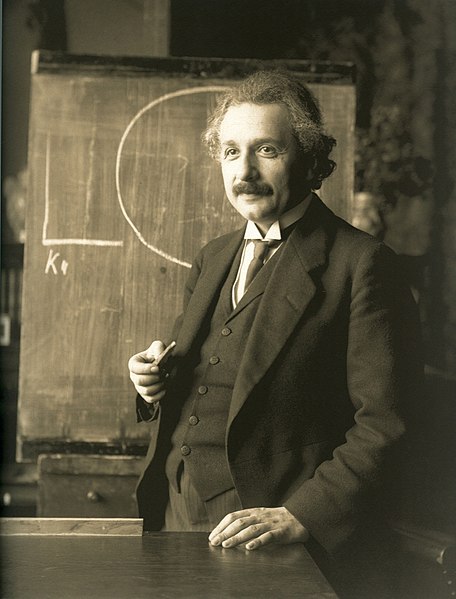
One of Einstein's most famous assertions was that gravity was not a force that pulled items toward the center of massive bodies, but that it was the result of massive bodies bending Space itself! Light always travels through Space in straight lines, but in such a regime, light could be bent, because Space itself was being bent. Think of a car versus a train. Cars have steering wheels, but trains do not. What's the difference? Trains are guided by tracks, whereas cars move along open unrestricted spaces and must therefore be guided by a steering wheel. In similar fashion, space is to light, what train tracks are to trains. Space guides light. While matter determines the shape of space. This succinct summary of Einstein's works, gave rise to John Archibald Wheeler's saying,
Spacetime tells matter how to move; matter tells spacetime how to curveJohn Archibald Wheeler
So precise. So much information in so short a thought. It was the epitome of the phrase: 'if you understand something you can explain it simply,' and 'if can't explain something simply, you don't understand it well enough.' Truly, mankind had reached a milestone. Just like trains themselves, are always moving straight ahead - so does light. They can be directed to bend by their tracks, and so can light by its 'tracks' - space. What was needed now, was a Hertzian figure who could verify experimentally, science's great new philosophy. Enter, Sir Arthur Eddington.
The Solar Eclipse and the Bending of Light
The Arthur Eddington experiment was limited to a field trip of discovery, wherein, he traveled to view an eclipse - in order to confirm Einstein's intuition that light bends in the presence of strong gravitational fields. He conducted it in 1918.
Einstein's two paradigm-shifting papers, on the The Theory of Special Relativity, and Theory of General Relativity were written 10 years apart, with the first one being published in 1905. 1905 proved to be a most fruitful year for Einstein and his ideas. He wrote four widely acclaimed papers in that year: I will list the subjects and not the titles, as that is more helpful, namely: a paper on the Photoelectric Effect, which we covered earlier; one on Brownian Motion; the third, was the one on Special Relativity, and in it he argued that, "... the idea of a luminiferous aether - one of the leading theoretical entities in physics at that time - was superfluous* (Einstein article: Under subheading 'Special relativity - Wikipedia');" and lastly, his fourth paper which covered the subject of Matter-energy Equivalence, and from which we have the famous E = mc2 equation. You might know that Einstein received only one Nobel Prize in his life and he died in 1955. Nevertheless, his Nobel prize was awarded for his paper on the photoelectric effect. The photoelectric effect, is the phenomenon in nature that provided evidence for light being a particle - which Einstein, named a "photon." This view, had gone out of vogue, since originally proposed by Newton (who named his light particles "corpuscles"), as experimental evidence for light behaving as a wave had been established. The definition of the word corpuscles: "A discrete particle, such as a photon or an electron* (Wordnik online dictionary)," shows that Newton's ideas covered today's accepted reality. After empirical evidence for a photon had been established, it was excepted that light showed both wave-like and particle-like behaviours, hence the now accepted wave-particle duality of light. Einstein kept developing his ideas on relativity, writing another paper in 1907 that charted his thinking, and finally nailing down his fully developed ideas with the 1915 publication of his theory of General Relativity.
Noted theoretical physicist, Brian Greene, another science figure, cut-out in the mould of Neil deGrasse Tyson and Brian Cox, explains the development of Einstein's ideas over the intense 8 year period, from 1907 to 1915, explaining how he processed his ideas in stages. With Special Relativity, the 1905 paper, Einstein had dealt heavily with one kind of motion: constant motion, and in the second - General Relativity - he applied what he knew about motion to acceleration - a closely related topic. Motion under acceleration was how Einstein imagined gravity worked. For him, the central idea behind gravity was opposite to Newton's understanding. Newton believed gravity was the manifestation of forces pulling bodies towards each other, it's just that he didn't know the mechanism that mediated the force, hence his statement: "Thus far I have explained the phenomena of the heavens and of our sea by the force of gravity, but I have not yet assigned a cause to gravity." He died before figuring it out. On the other hand, Einstein believed gravity was an illusion, a feeling of being pulled down toward the earth, that was actually caused by the opposite dynamic. Gravity, he felt, was not the act of being pulled downward by a force, but the simulated effect of the earth accelerating upward beneath you. Excerpts from Greene's analysis of Einstein's ideas follows. In an interactive discussion hosted by World of Science Festival, Greene explains the mechanics of this, with host Alan Alda of Mash fame - an avid science geek. Alda asks him about Einstein's "moment of a man falling of a building ... happiest thought of his life. Why was that the happiest thought, Because that sounds like he's saying, its the most central image to all his thinking?"
Yeah, that was the key idea that propelled him toward the general theory of relativity. See, gravity is a difficult subject, it's hard to even figure out a way in to a description of the force of gravity.... What he realized, was that a certain kind of motion: freely falling motion, in essence counteracts gravity, can eliminate gravity. Which means, in any situation where there's gravity, if don't want to have to deal with it directly, just execute a certain kind of motion: jump out a window, and then gravity goes away!"
The absurdity of the explanation was not lost on Alda. "What!" he immediately exclaimed, through audience laughter. "You jump out a window, gravity makes a quick entrance!" More audience laughter. Sheepishly Greene interjects: "Actually, eh eh, actually it doesn't," he says squirming in his seat.
So you jump out a window, what actually happens from Einstein's perspective is the ground is just rushing up and hitting you. You're not being pulled down by gravity from Einstein's perspective. I mean when Newton was sitting there under the tree, according to Einstein, it was not that the apple fell on his head, his head rushed up and hit the apple" Brian Greene
Lada, cannot contain his disbelief, throughout the explanation he has a grin from ear to ear, for obvious reasons. You might first have been struck by the fact that Einstein's theory was to a means to counteract gravity, not explain it. An brain teaser is why the man who falls out of the building is described as falling, in the first place. If gravity is not a force that pulls objects downward, the man would not fall where he to step out of the window; he would merely levitate, like Wile E Coyote running off a cliff, in the Road Runner cartoons. Have Etherists come to that level of discussion. I will prove to you why they are Etherists, shortly. A third, and obvious objection to this fairytale is that we know the earth is not accelerating upwards at all! If this is how the earth simulated gravity, it, as a sphere would have to accelerate outward radially, in all directions simultaneously! That would mean the earth is continually growing in size. Its radius would keep increasing as it expanded. Greene tries to explain this simulated effect with Einstein's original thought experiment: the man in an elevator in outer space - where there is no gravity.
If you are standing on a scale, right, you look down, you see whatever, you know 150, 160 for me - something like that, right. If I jump out of the window with a scale at my feet and I look down on it, what does the reading go to? It goes to zero, because the scale and me, we are moving together. So in that, I'm no longer pushing on the scale, I'm no longer experiencing gravity as I did when I'm standing here on the stage" Brian Greene
From this description, it becomes obvious that Greene and Einstein are describing, not gravity, but tension. When I was young, I used to hold my fathers hand when we crossed the street, and by the way he moved his hands, he would create tension that told me "go," or "stop," without using words. Also as I was much shorter than him, there was constant tension, because he walked faster than me, and I would have to adjust my pace every several steps to catch up. As I grew older, I still held my father's hand, but I could keep up easier with his walking pace and, now also knowing the rules of the road, he didn't have to give me inputs through his hands: I knew, on my on when to walk and when to wait. That's tension. Tension is different from gravity. When you play tug of war, before the game starts both teams ar holding the rope in their hands, but it's slack. There's no tension. As they are about to start pulling, they ready themselves by pulling the rope taut. At this point they introduce tension. That is analogous to Greene's description and is not a fitting explanation for gravity which is always present between two or more bodies!
Gravity (from Latin gravitas 'weight'), or gravitation, is a natural phenomenon by which all things with mass or energy, including planets, stars, galaxies and even light, are attracted to (or gravitate toward) one another." Gravity - Wikipedia
Greene continues:
So, if you can counter gravity, if you can cancel it out, by going into this motion, Einstein realized the reverse was also true! You can mock up gravity, you can simulate gravity, by accelerating too! ... If you cut the cable of an elevator, then indeed, you and and the elevator will fall together ... just like the scale and my feet fall together, you don't feel anything. The exact reverse of that is now take an elevator in empty space - no gravity - empty space! And pull up on the cable, making the elevator accelerate in that direction, and if you're in that elevator, you will now feel your feet pressing against the floor, because the floor is pushing up against you. You will have simulated gravity." Brian Greene
Again, there are obvious flaws in the reasoning. Firstly, free-falling is not an absence of gravity, but its very definition. Secondly, the fact that you are falling is not equivalent to his statement "... you don't feel anything." Falling is a distinct sensation! If it wasn't, there would be no hesitation for people to go sky diving, and no incentive for adrenaline junkies to go skydiving! Again, absurdities that don't comport with reality. Alas, the madness continues. Putting it all together, Greene explains,
Why is that important? Einstein understands motion really well, but he doesn't understand gravity. Now he has reduced gravity to motion! Accelerated motion. That gives him a way in, and it does take him a good eight years to fill in all the details, but that yields the general theory of relativity.... He ignored gravity in 1905 ... he only took into account motion that was not speeding up, not slowing down, no accelerated motion. When he included accelerated motion, all of a sudden gravity comes into the story for free, in the manner that we're just describing, because accelerated motion, makes gravity, makes it all of a sudden appear, even though it wasn't there necessarily to begin with - and that's the window into the general theory of relativity" Brian Green
If the 'equivalence principle' is the window, what is the house? How does the equivalence principle relate to the illustrations we see of what general relativity in action is supposed to look like: the 2 dimensional analogies of spacetime as shown below? Newton's explained gravity as a force, which means it has "mediating particles" that act between the two or more bodies, it is attracting toward each other. The unfinished aspect of that theory was that Newton didn't find those "mediating particles," and his theory was left with a whole in it, which made Newton "... deeply uncomfortable with the notion of 'action at distance' that his equations implied.* (Newton's Law of Universal Gravitation: Under th subheading Newton's Reservations - Wikipedia) "Action at a distance," meant one object could affect another without physical contact, even over large distances on a galactic scale. Like scientists after Copernicus tried to alter the meaning of him stating the Sun and not the Earth, was the center of the universe; like they tried to downgrade Clausius great work and Faraday after him; some have tried to paint the "action at a distance" narrative as if it was something Newton advocated for, when nothing could be further from the truth! In the Action at a Distance, article in Wikipedia, under the subheading Newton, one such scholar is quoted:
... A phenomenon in which a change in intrinsic properties of one system induces a change in the intrinsic properties of a distant system, independently of the influence of any other systems on the distant system, and without there being a process that carries this influence contiguously in space and time" Berkowitz
Contiguous, means: touching, or sharing a common boundary, in other words, something affecting something else, through continuous forward contact, through mechanical means. But we know that is not how Newton felt about his lack of ability to identify the "particles of mediation" for the force of gravity. Not only did he not advocate for such a description of gravity, he stated forcefully, his opposition to it. From another on Wikipedia, this time the Newton's Law of Universal Gravitation, we get the following quote
While Newton was able to formulate his law of gravity in his monumental work, he was deeply uncomfortable with the notion of 'action at a distance' that his equations implied. In 1692, in his third letter to Bentley, he wrote: 'That one body may act upon another at a distance through a vacuum without the mediation of anything else, by and through which their action and force may be conveyed from one another, is to mea so great an absurdity that, I believe, no man who has in philosophic matters a competent faculty of thinking could ever fall into it. Gravity must be caused by an Agent acting constantly according to certain laws; but whether this Agent be material or immaterial, I have left to the Consideration of my readers'" Sir Isaac Newton, Letters to Richard Bentley, 1692/3 (Action at a Distance Article - Wikipedia)
Newton was resolute in his insistence that no appeal be made to metaphysics, in an effort to explain gravity, chiding those who resorted to metaphysical ethers. As far as his own ideas, he stated:
I have not yet been able to discover the cause of those properties of gravity from phenomena, and I frame no hypotheses; for whatever is not deduced from the phenomena is to be called a hypothesis, and hypotheses, whether metaphysical or physical, whether of occult qualities or mechanical, have no place in experimental philosophy." Newton's Law of Universal Gravitation: Under the Subheading 'Newton's Reservations' - Wikipedia
And again ...
It is enough that gravity does really exist and acts according to the laws I have explained, and that it abundantly serves to account for all the motions of celestial bodies" Newton's Law of Universal Gravitation: Under the Subheading 'Newton's Reservations' - Wikipedia
For Newton, as is true for all good science, hypotheses and the power of reason are contradictory. Though, speaking of applying these methods to a different problem, he nonetheless, outlines the guiding principle of the "scientific method,"
My Design in this Book is not to explain the Properties of Light by Hypotheses, but to propose and prove them by Reason and Experiments: In order to which, I shall premise the following Definitions and Axioms" Sir Isaac Newton
As proof of his dogged determination to avoid getting credit for something he hadn't yet accomplished, Wikipedia makes the following statement:
He never, in his words, 'assigned the cause of this power.' In all other cases, he used the phenomenon of motion to explain the origin of various forces acting on bodies, but in the case of gravity, he was unable to experimentally identify the motion that produces the force of gravity (although he invented two mechanical hypotheses in 1675 and 1717). Moreover, he refused to even offer a hypothesis as to the cause of this force on grounds that to do so was contrary to sound science. He lamented that 'philosophers have hitherto attempted the search of nature in vain' for the source of the gravitational force, as he was convinced 'by many reasons' that there were 'causes hitherto unkown' that were fundamental to all the 'phenomena of nature.' These fundamental phenomena are still under investigation and, though hypotheses abound, the definitive answer has yet to be found" Newton's Law of Universal Gravitation: Under the Subheading 'Newton's Reservations' - Wikipedia
Einstein, too, was dogmatic about instantaneous action at a distance, but for completely different reasons! Newton accepted that one body could affect another over large distances, but was merely lacking the means by which the gravitational force effected such action. He was confident though, that in time, it would come to light. Einstein, was the complete opposite he thought the very notion of instantaneous action at a distance was a breach on the speed of light, which to him, formed the upper limit of how fast information could travel. For instance, we know it takes light just over 8 minutes to reach the earth from the Sun. But in such a scenario, if one body suddenly moved its position and there was another body that it was attracted to gravitationally 1 astronomical unit away, it would respond to that displacement instantaneously. Einstein, in effect says, it should take 8 minutes and change before it can respond. So, to him, its not a matter of instantaneous action at a distance missing a mediating particle. It's that instantaneous action itself, would be a violation of the speed of light, which acts as a universal speed limit for all physical matter.
But, we can ask ourselves the question: how does Einstein go from his equivalence principle, to addressing how gravity works in his theory of general relativity? We have three factors: 1) the equivalence principle describes how he thinks gravity manifests itself 2) he doesn't believe in mediating particles, for gravity by definition is a force that acts over large distances, and he thinks a force acting over such large distances, even if we knew what acted as its mediating particle - which Newton didn't know - would violate the speed of light and therefore causality; 3) since, his definition of gravity doesn't incorporate mediating forces, he needs another mechanism to produce its effects. These three factors place the unique requirement on Einstein, that whatever his solution is, it cannot be a force! That is peculiar indeed, as all other phenomena are forces mediated by carrier particles. Carrier particles, being the agents that convey the force from one entity to another. Einstein's solution, is that gravity is not a force at all, but an effect caused by the curvature of his 4-dimensional spacetime. So here, "the window" that is, the equivalence principle and its gravitational effect caused by free fall, meets the house: the curvature of spacetime, which causes free fall as is often shown on YouTube, when with a trampoline type surface, has a heavy bowling ball type object placed in its center. This results in the center of the trampoline sinking down. Then, a marble or tennis bowl is whizzed around the periphery of the trampoline, until it gradually starts to circle inward until it inevitably touches the bowling ball and stops moving. This demonstration is supposed to be a rough illustration of how gravity works.
Though, he accomplished many things in life, our interest in Einstein centers around those of his contributions that add to the narrative that leads us, in the end to Dark Matter, thus the importance of his understanding of space and gravity to us. His other credits have value in themselves, but they add nothing to our central discussion.
Since Space also bent when in the presence of massive objects, like the Sun, gravitational fields were also especially strong around massive objects. Space was always bent around such objects, thereby affecting the course of light rays in such vicinities. This bending of space around massive objects, is what produces gravitational lensing, by the way. The two greatest proofs of this are, light rays from a distant star bending around the sun in the 1918 solar eclipse, and gravitational lensing on a galactic scale throughout the universe! As revolutionary as his ideas were, in one very particular way Einstein regressed back to the oldest of all metaphysical practices - Etherism, the invoking of an ether, to describe parts of our theory that we cannot readily explain - otherwise. As Brian Greene continually tries to - incoherently - explain, somehow: "gravity disappears" when you free-fall. Einstein's 1905 theory of special relativity abolished the luminiferous ether of Michelson-Morley fame, just like Antoine Lavoisier abolished the Phlogiston theory when he established chemistry, that much is well known. What you might know, is that again, just like Lavoisier, after having effectively abolished the need for an ether, his 1915 paper once more, invoked an ether. Explaining how this happened, Matt O'Dowd describing how developments led to the recycling of the ether:
It's commonly stated that the ether is disproved, but let's be clear: the ether as a classical medium for light is dead! However, the general concept of the ether sort of has an afterlife. Einstein talked about the 'new ether,' as the medium of the gravitational field, and which we now think of as the fabric of spacetime. Paul Dirac, suggested that a 'particulate ether' could explain the near vacuum state of spacetime, in which quantum physicists believe particle pairs are quickly born and destroyed. In retrospect, Descartes seems prescient: empty space is not really empty. It's flowing fabric is the source of the gravitational field...." How Luminiferous Ether Led to Relativity - Matt O'Dowd
The similarities with Lavoisier and Priestley don't end there. Just like then, so it was with Einstein and Albert Michelson. Again, O'Dowd explains,
And what about Albert Michelson? Well, it seems he could never bring himself to accept his own result. He appears to have believed in the luminiferous ether until the endHow Luminiferous Ether Led to Relativity - Matt O'Dowd
Einstein's theory of relativity is nothing like Newton's, which preceded it. When asked if stood on the shoulders of Newton, he replied: "No, on the shoulders of Maxwell." In this he was not lying. Einstein, like Maxwell, believed in imbuing space with special properties, as borne out by the way he formulated his equations. How far the apple had fallen, from the Scientific tree!